Once Social Property – Always Social Property
Conversation with Nebojša Milikić
Tuesday, September 13, 2011
Hall of the local community “Studentski Grad”, Narodnih heroja 30, Novi Beograd
Context in a local community – conversation with Nebojša Milikić
The process of writing template graffiti “ONCE – ALWAYS! SOCIAL PROPERTY” involves marking the former social property in order to enable all future researchers and competent services to more easily locate material goods that were stolen from society through privatization. The marking process will most likely last several decades because the material is very extensive.
Rethinking the concept of social or common has its concrete consequences in the countries of former socialism – in the best case – disbelief, in the usual – censorship, in the most negative – pressures and threats aimed at separating the issue of community, cooperation, solidarity from the issue of property and property relations.
The started process of marking social property is the result of its implementer dealing with issues of community and the common in residential buildings, suburban settlements, state institutions and work organizations, where this repressed property issue appears as the smallest common content of their particular problems.
The audience will be presented with documentation about the spaces and objects marked so far, and analyzed some examples of the latent presence of this issue in projects such as the series of radio shows “Our Building” or “Flux below us – Kaluđerica”. The given examples will serve as a reason to discuss the wider social and political implications of the transfer of property created through joint work from social to private ownership.
Nebojša Milikić (Belgrade, 1964) has been engaged in artistic production, independent research work, writing about art and social activism since the mid-1990s. Since 2001, he has been working as an editor or program coordinator at the Rex Cultural Center. Initiator and/or coordinator of the KEF, Flux, Kvasac projects, as well as the series of Speech Programs and the Program for the Democratization and Decentralization of Culture of the Rex Cultural Center. He is a member of the Working Group of the Ministry of Culture for maintaining cultural diversity and intercultural dialogue.



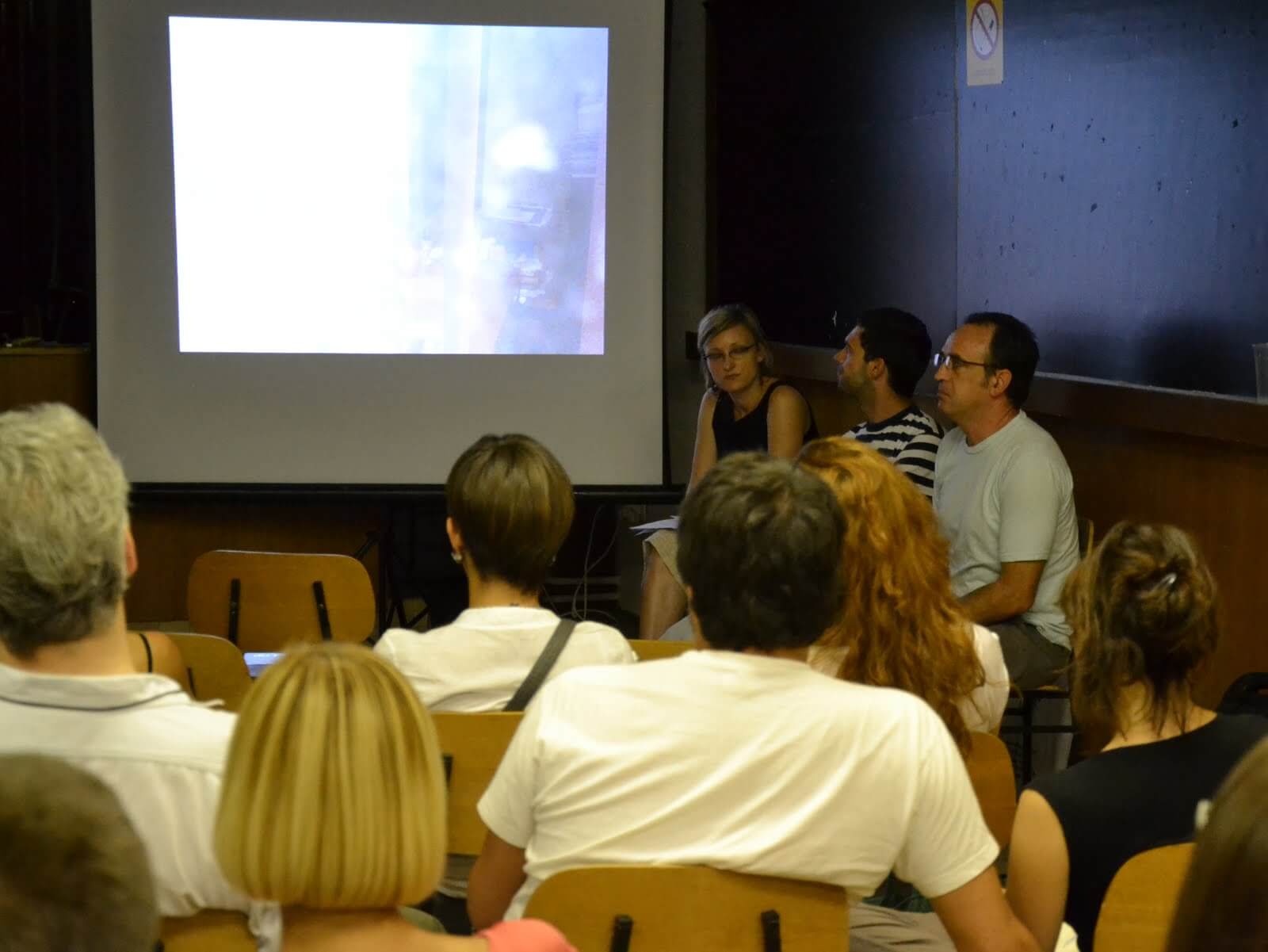




With this program, we open Context in the local community
The Kontekst in a local community represents the continuation of our struggle for an autonomous space, which we started after the cessation of work in the space of the “Stari Grad” Cultural Center in October 2010. That struggle represents a self-organized pressure on the network of exploitation of contemporary art and culture, as well as the creation of different production relations in which art would be a repoliticized place of social dialogues or conflicts as a driver or consequence of contemporary political processes.
Previous research and communication with various management structures in the area of local cultural policies resulted in the signing of a contract with the Municipality of New Belgrade, which opens the possibility for further work in the area of the “Student City” local assembly in New Belgrade. We will use the period of work in the local community to create a platform of autonomous education as an opportunity for co-production of new knowledge and for such knowledge related political action.
The local community (municipal sub-administrative unit) is the lowest instance of the state organization. Their establishment in the SFRY began in the mid-1960s, while in 1974 they entered the Constitution as the basic form of self-governing organization of citizens at the local level. Local communities then became centers for citizens’ organizing in terms of meeting their needs, such as built infrastructure, kindergartens and schools, sports fields, and for organizing cultural and educational programs. These activities were the result of citizens’ uniting, who, through self-contribution and personal work, improved living conditions in their local communities. The obvious successes notwithstanding, these places of local self-government over time became usurped by local parties and thus also increasingly distant from the residents and their initiatives. In addition, at least declaratively, in the current laws there are opportunities for organizing people and their participation in decision-making through the instance of the local community. Forms of direct participation of citizens in the realization of local self-government – citizens’ initiative, assembly of citizens and referendum – are rarely achievable in the practice of the modern political system, and work should be done to strengthen them.